
Made-to-measure clear or back-painted splashback
Glass splashbacks at a glance
Before going into detail, here is what makes a glass splashback an alternative to tiles in a kitchen.

A joint-free surface
A single smooth panel that traps neither grease nor mould.

A quick wipe is all it takes
Glass cleaner and a soft cloth, without strong solvents or abrasive sponges.

Made to measure to the millimetre
Cut to the dimensions of your wall, with cut-outs for sockets, to within -1 / +1 mm up to 2 m.

Made for the hob
In toughened glass at least 6 mm thick, it is suitable for induction, ceramic and gas hobs.
The made-to-measure clear splashback
A clear glass splashback protects the wall while preserving the original look of the kitchen: paint, tiles, brick or wallpaper remain visible. It can be made in clear glass, low-iron glass or tinted glass in grey, bronze, dark grey or dark blue. Transparency adds depth to the worktop and makes the walls feel lighter.
A translucent splashback is made in clear or low-iron frosted glass: it hides imperfections in the wall and creates a softer atmosphere.
Gloss or matt, a clear splashback is fixed to the wall mechanically (holes and fixing screws) or on a rail, as adhesive would be visible through the glass. For total transparency, with no green tinge on the edge, choose low-iron toughened glass.
To create your made-to-measure toughened glass splashback, use one of our two configurators:
The back-painted splashback
Back-painted glass offers a huge choice of colours, from the RAL, NCS and Pantone charts. The paint is applied to the back of the toughened glass, in a spray booth under a controlled atmosphere, for a perfectly even result; seen through the glass, the colour is glossy and protected. At Plakglass, each painted panel is protected by a film on the back for transport, handling and fitting. A thickness of 6 mm is ideal for a cooker hood splashback.
Back-painted glass is bonded to the wall with an adhesive whose solvents do not attack the paint: Plakglass offers the right adhesive. Using any other bonding product does not guarantee that the paint will hold up over time.
The most popular splashback colours
Colours shown for guidance only: the appearance varies depending on your screen and its settings.

Red splashback
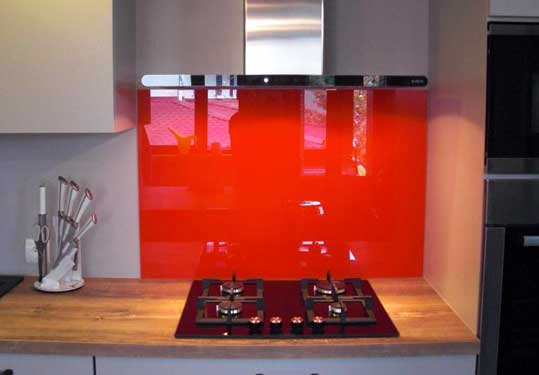
Brick red back-painted glass splashback behind a gas hob, under a cream cooker hood, in a warm kitchen

Orange splashback
Terracotta orange back-painted glass splashback behind a gas hob, bright kitchen with an oak worktop

Yellow splashback
Mustard yellow back-painted glass splashback behind a gas hob, under a cream chimney hood

Green splashback
Sage green back-painted glass splashback behind a gas hob, natural kitchen with a green plant and wooden utensils

Blue splashback
Teal blue back-painted glass splashback behind a gas hob, under a cream cooker hood, in a bright kitchen

Plum splashback
Plum aubergine back-painted glass splashback behind a gas hob, warm kitchen with a wooden worktop

Taupe splashback
Taupe back-painted glass splashback behind a gas hob, soft atmosphere with an off-white wall and a cream cooker hood

Grey splashback
Anthracite grey back-painted glass splashback behind a gas hob, bright kitchen with an oak worktop

Black splashback
Glossy black back-painted glass splashback behind a gas hob, with mirror-like reflections, under a cream cooker hood

White splashback
Cream white back-painted glass splashback behind a gas hob, glossy surface in a light, warm kitchen
Edgework and cut-outs for toughened glass splashbacks
We offer many edgework options for splashbacks, clear or back-painted: cut-outs for sockets and switches, holes, fixing holes, bevels, rounded or clipped corners, edge notches and various shapes (L-shaped, U-shaped, arched…). All edgework is carried out before toughening.
As a cooker hood splashback, the glass must be at least 6 mm thick; with a gas hob, position it at least 10 cm from the flame. A cooker hood splashback is generally 60 to 75 cm high. Toughened glass is an excellent replacement for tiles: more resistant than standard glazing to impacts, heat and scratches, it gives a modern look to both kitchen and bathroom.
The splashback is made to measure in France and delivered to your home in secure packaging suited to its size, with short lead times.
Our glass splashback projects
A selection of splashbacks and cooker hood splashbacks made in our workshop and fitted by our customers: red, black, turquoise, white or salmon pink back-painted glass, in gloss or matt.
Bright colours to give the kitchen character, blacks and whites for a sleek, contemporary style: back-painted glass suits every layout, along the full length of the worktop or just behind the hob.
Frequently asked questions about glass splashbacks
Clear or back-painted glass splashback: which should I choose?
A clear splashback protects the wall without hiding it: ideal in front of paint, brick or tiles that you want to keep visible. A back-painted splashback provides a solid, opaque colour that hides the wall and its flaws, in the colour of your choice. Frosted glass, in between the two, lets the wall show through faintly while softening its appearance. All three are made of toughened glass and are suitable behind a hob.
How do I fix a clear glass splashback?
A clear splashback is fixed mechanically, with holes and decorative fixing screws, or on a rail, as adhesive would be visible through the glass. The holes are made in the workshop before toughening: position them in the configurator. A back-painted splashback, on the other hand, is bonded to the wall with an adhesive compatible with the paint.
Which glass should I choose for a clear splashback?
Standard clear glass has a slight green tint, visible on the edge and against a white wall. For total transparency, choose low-iron glass, which is almost colourless. Tinted glass (grey, bronze, dark grey, dark blue) gives a smoked splashback, and frosted glass a translucent splashback that hides imperfections in the wall.
What thickness and distance for a splashback behind a hob?
Behind a hob, the splashback must be made of toughened glass at least 6 mm thick. It is suitable for all types of hob: induction, ceramic and gas. With a gas hob, keep at least 10 cm between the flame and the glass, ideally 12 to 15 cm. A cooker hood splashback is generally 60 to 75 cm high.
Which standard does a toughened glass splashback meet?
The glass in our splashbacks is thermally toughened safety glass to European standard EN 12150: around five times stronger than ordinary glass, it shatters into small, blunt pieces if it breaks. Back-painted glass also belongs to the family of painted glass for indoor use, covered by standard EN 16477, and has a safety film on the back. Cut-outs and holes are made before toughening.
Can a glass splashback replace tiles?
Yes: fitted directly onto the wall, a toughened glass splashback replaces tiles behind the sink and hob. With no grout lines, it does not hold grease or mould and can be cleaned with a microfibre cloth and a non-abrasive product. It can also be fitted over existing flat tiles, provided the surface is clean and even.