
Made-to-measure frosted glass
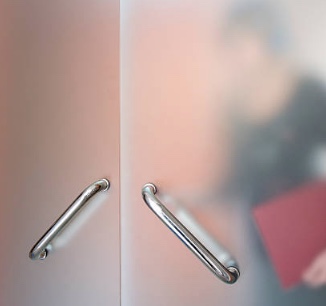
Frosted glass or satin glass
The “frosted” look is obtained by a process that etches the surface of the glass with acid: one side becomes matt and the other remains glossy and smooth. Acid-etched glass is both practical and decorative, appreciated for its satin effect, its matt appearance and its ability to provide privacy: it blurs the view of everything behind it.
Its translucent surface filters and diffuses light evenly, which makes it a favourite material for interior design and decoration. It has a “peach skin” feel over its entire surface and goes by several names: frosted glass, satin glass or matt glass.
Get the price of your made-to-measure frosted glass by configuring it below.
Configurator: frosted glass
1Click the shape of your cut-out
Rounded and clipped corners are set in step 3.
Edge, corner and middle notches are set in step 8.
Classic shapes
Shapes with arcs
3- and 4-sided shapes
Shapes with 5 or more sides
2Enter the dimensions
Tip: swap the height and the length if your piece is taller than it is long.
Manufacturing tolerance: -1 / +1 mm All measurements are in millimetres (mm). Overall size of the piece: 100 × 60 cm
3Corner customisation
The corner numbers are marked on the drawing.
4Choose the thickness and the glass
Transparent glass
5Edgework
All edges are supplied with a flat polished edge (JPP): smooth, glossy and not sharp.
Polished, glossy and smooth edge face.
45° bevel:7Fixing holes
8Holes, cut-outs and notches
Ref. X and Ref. Y are measured from the left edge and the bottom edge of the glass: to the centre for a round hole or a socket; for a rectangular or oblong cut-out, to the centre of the cut-out, or if you prefer to the bottom left corner (rectangle) or to the centre of the bottom or left semicircle (oblong). Click on the drawing to view it full size.
They ordered their frosted glass
4.92/5 · 98 verified reviews for frosted glass
- ★★★★☆
“The description just needs to be more precise.”
Translated from FrenchLow-iron frosted glass 6 mmEnid B. · November 2024 - ★★★★★
“Superb, the top I received fully meets my expectations”
Translated from FrenchClear frosted glass 10 mmCatherine D. · October 2024 - ★★★★★
“Really lovely, good-quality panel! Delivered without any problems. We're happy with the effect of this product”
Translated from FrenchClear frosted glass 5 mmNelly P. · January 2024
Verified customer reviews · Société des Avis Garantis
Frosted toughened glass specifications
| Description | Frosted toughened glass |
|---|---|
| Frosting | Acid-etched |
| Finishes available | Clear and low-iron |
| Minimum size (rectangle / round) | 178 × 80 mm (250 mm diagonal) / 250 mm diameter |
| Maximum size (rectangle / round) | Length 2,900 × height 1,800 mm / 1,800 mm diameter |
| Thicknesses available | 4, 5, 6, 8, 10 and 12 mm |
| Origin of the glass | Major European glassmakers |
Acid-etched frosted toughened glass
Acid-etched frosted glass has a surface treated to reduce transparency while still letting light through consistently. It lets you screen areas while keeping plenty of brightness, and is perfect for interior fit-outs and discreet room dividers.
How frosted glass is made
Plakglass sells frosted glass that is acid-etched. There are two techniques for achieving the translucent effect:
Hydrofluoric acid treatment
The glass surface is exposed to a chemical agent that creates a multitude of micro-irregularities. The longer the treatment, the more opaque the surface becomes. This process gives an even, uniform finish on the frosted face.
Sandblasting
An abrasive jet is blasted onto the glass to alter the surface. The intensity and duration of sandblasting vary the level of translucency.
Characteristics and appearance
Frosted glass diffuses light while softening the view and blurring what is behind it. Its satin finish makes it an effective solution for living spaces, offices or bathrooms that need privacy.
Uses in interior design
Frosted glass is found in many interior projects: partitions, doors, internal windows, shower screens, or laminated glass balustrades.
In a hallway or corridor, a sliding door creates a separation while keeping the area bright. In a bathroom, frosted glass is used for shower screens or internal windows that need an obscuring effect. In the kitchen, it is used for splashbacks, cabinet fronts or doors and glass partitions: it protects walls, is easy to clean and is cut to the dimensions of the worktop, with socket cut-outs.
Its flat surface keeps cleaning simple, which makes it well suited to wet rooms. It is also widely used in professional spaces: offices, meeting rooms, shops or reception areas. Whether used to protect, separate or clad a wall, a top or a worktop, it lets you organise an interior without reducing the amount of light.
Your customisation options
- Cut to your dimensions
- Special shapes: rectangle, square, round, trapezium…
- Thicknesses from 4 to 12 mm
- Clear or low-iron frosted toughened glass
- Flat polished edges
- Bevelled edges and rounded corners
Order your frosted glass online
Configure the dimensions, thickness and options online: each acid-etched frosted pane is made to order to match your needs exactly.
Made to your configuration
The glass is cut and processed in French workshops, to your measurements, in a clear or low-iron finish, in the shape you choose.
Made-to-measure frosted glass products


Frequently asked questions about frosted glass
What is the price per m² of frosted glass by thickness?
The price depends on the thickness and finish. For a rectangular shape, price per m² of frosted toughened glass:
- clear frosted 4 mm: from 93.20 €/m²
- clear frosted 5 mm: from price online
- clear frosted 6 mm: from 115.70 €/m²
- clear frosted 8 mm: from 134.20 €/m²
- low-iron frosted 6 mm: from 144.10 €/m²
The exact price is shown in the configurator according to your dimensions, shape and options.
What is frosted glass and how is it made?
The frosted glass offered by Plakglass is produced by acid treatment: the glass surface is chemically etched, creating a multitude of micro-irregularities and a matt, satin look, without changing its thickness or its strength once toughened. This process is different from sandblasting, which works mechanically by blasting an abrasive.
What is the difference between frosted, sandblasted and satin glass?
Frosted and satin generally refer to the same result, obtained by acid treatment of the surface: an even finish that is soft to the touch, also called obscured or matt glass. Sandblasted glass is produced by mechanically blasting sand or beads, giving a rougher and sometimes less even look. Plakglass uses acid for its finer, more consistent finish.
Does frosted glass let light through?
Yes: acid-etched glass diffuses light rather than blocking it, unlike opaque glass. The room stays bright while gaining privacy, as the direct view is blurred without being completely blocked. The light loss is estimated at between 15 and 20% compared with a clear pane, and glare is eliminated.
Where can frosted glass be used in the home?
Anywhere you want light without full transparency: shower screens, bathroom doors, partitions and sliding doors, glass partition walls and internal windows. In the kitchen, it is used as a splashback, cabinet front or door, with a softer effect than gloss glass. For outdoor or highly exposed use, the thickness is chosen case by case.
Why choose frosted toughened glass?
For safety: toughened glass is around five times more impact-resistant than ordinary glass and, if it breaks, it shatters into tiny, blunt pieces. This is essential for a door, a shower screen or a partition. Holes, notches and cut-outs are made before toughening.
What standard does frosted toughened glass meet?
Plakglass frosted toughened glass is a thermally toughened safety glass conforming to European standard EN 12150 ("Thermally toughened soda lime silicate safety glass"). This standard defines the toughening process, tolerances and fragmentation test: if it breaks, the glass must shatter into small, blunt pieces. The clear or low-iron base glass is float glass conforming to standard EN 572; acid etching only changes the surface appearance. For a balustrade or an area with a risk of falling, you need laminated safety glass, covered by standard EN 14449.
Clear frosted or low-iron frosted: what is the difference?
Acid-etched clear glass retains the slight natural green and blue tint of glass, visible mainly on the edge. Low-iron frosted glass is made from glass without this tint: it is whiter and almost neutral. Please note: frosted glass is not available with the anti-limescale coating, as these two surface treatments are not compatible.
How do I clean frosted glass without marking it?
Use soapy water or a standard glass cleaner with a soft, non-abrasive cloth. Avoid scouring sponges, strong solvents and harsh cleaners: they can damage the frosted face and create irreversible shiny patches. Fingerprints are naturally less visible on frosted glass than on gloss glass.