
Made-to-measure toughened fluted glass
Made-to-measure toughened fluted (reeded) glass
Fluted glass, also known as reeded glass or ribbed glass, has fine vertical grooves on one side. It lets light through while blurring the view: shapes and colours can still be made out, but details disappear.
Plakglass cuts your fluted glass to your exact measurements, finishes the edges and then toughens it, turning it into toughened glass (Securit), around five times stronger than ordinary glass.
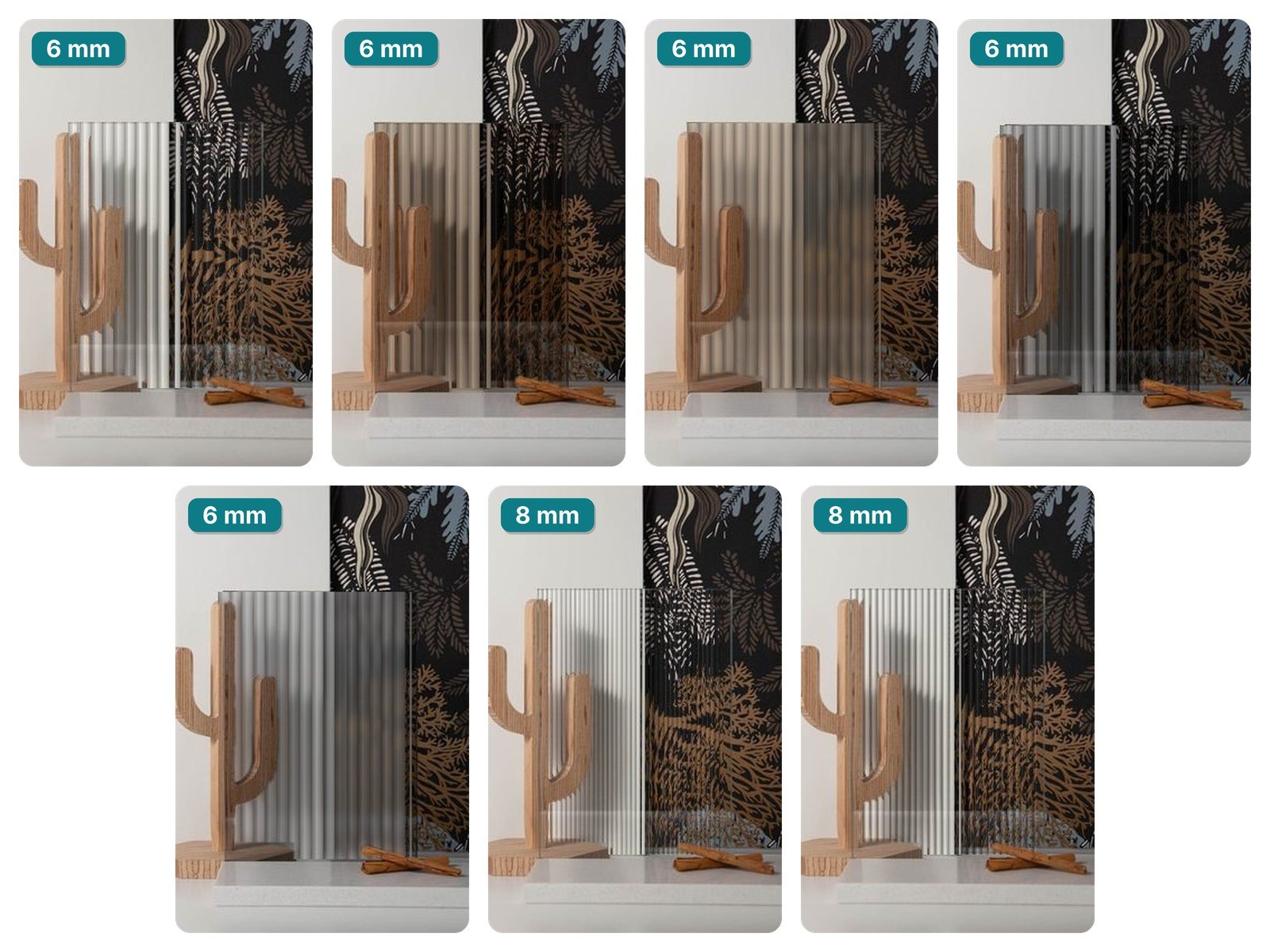
- Glass types: clear, bronze or grey fluted, transparent or frosted, Visio Sun and Raywall 90
- Thicknesses: 6 mm for clear, bronze and grey fluted; 8 mm for Visio Sun and Raywall 90
- Flutes: always vertical, running along the height of the glass
- Holes, notches and cut-outs: positioned in the configurator, made before toughening
- Edges: flat polished edges, not sharp
Configurator: fluted glass
1Click the shape of your cut-out
Rounded and clipped corners are set in step 3.
Edge, corner and middle notches are set in step 8.
Classic shapes
Shapes with arcs
3- and 4-sided shapes
Shapes with 5 or more sides
2Enter the dimensions
Tip: swap the height and the length if your piece is taller than it is long.
Manufacturing tolerance: -1 / +1 mm All measurements are in millimetres (mm). Overall size of the piece: 100 × 60 cm
3Corner customisation
The corner numbers are marked on the drawing.
4Choose the glass thickness
Transparent glass
5Edgework
All edges are supplied with a flat polished edge (JPP): smooth, glossy and not sharp.
Polished, glossy and smooth edge face.
45° bevel:7Fixing holes
8Holes, cut-outs and notches
Ref. X and Ref. Y are measured from the left edge and the bottom edge of the glass: to the centre for a round hole or a socket; for a rectangular or oblong cut-out, to the centre of the cut-out, or if you prefer to the bottom left corner (rectangle) or to the centre of the bottom or left semicircle (oblong). Click on the drawing to view it full size.
What is fluted glass?
Fluted glass is a patterned glass: during manufacture, the still-hot glass passes between rollers that imprint parallel grooves on one side. The other side remains smooth.
Each flute acts like a small lens: light passes through the glass, but the image is broken up into vertical strips. This is what gives fluted glass its decorative effect and its privacy, without darkening the room.
Fluted glass can be cut, edged and drilled like any other glass, before toughening. Once toughened, it can no longer be worked: enter every hole, notch and cut-out in the configurator.
Clear, bronze or grey fluted, transparent or frosted
Clear fluted glass keeps the most natural light. Bronze fluted adds a warm, amber tint that pairs beautifully with wood, brass and natural tones. Grey fluted gives a more graphic look, ideal with black frames and concrete.
In the frosted version, the bronze or grey glass has a satin finish: the blur is stronger and the light softer and more diffused. It is the choice for extra privacy, for example in a shared bathroom.
Visio Sun and Raywall 90
Visio Sun (Saint-Gobain) is a transparent glass with fine raised vertical lines: plenty of light passes through, while the view is heavily obscured.
Raywall 90 (AGC) features regular, crisp-lined ribs for a more architectural effect.
Both glasses are available as 8 mm toughened glass.
Where to use fluted glass?
Toughened fluted glass is ideal for rooms where you want both light and privacy:
- Shower screen and bath screen
- Interior partition and interior glass screen
- Interior or wardrobe door
- Furniture doors, sideboard or display cabinet doors
- Office, hallway or kitchen dividers
For a shower screen with fitting accessories (U-channels, stabilising bar), also use our shower screen configurator.
Caring for fluted glass
The flutes do a good job of hiding fingerprints. On the fluted side, clean along the flutes with a soft sponge or soft brush, warm water and a little washing-up liquid or diluted white vinegar, then rinse. The smooth side can be wiped like an ordinary window, with a squeegee or a microfibre cloth.
Never use scouring powder or cream, steel wool or a scraper.
Fluted glass technical information
| Glass types | Clear fluted, bronze fluted, bronze fluted frosted, grey fluted, grey fluted frosted, Visio Sun, Raywall 90 |
|---|---|
| Thicknesses | 6 mm (clear, bronze and grey fluted); 8 mm (Visio Sun, Raywall 90) |
| Flute direction | Vertical, along the height of the glass |
| Flute width | Clear, bronze and grey fluted: about 12 mm; Visio Sun: 5 mm; Raywall 90: 7 to 8 mm |
| Maximum dimensions: clear fluted and Raywall 90 | 1800 × 2900 mm (width × height) |
| Maximum dimensions: bronze and grey fluted, Visio Sun | 2000 × 1800 mm or 1800 × 2400 mm (width × height) |
| Edges | Flat polished edges, not sharp |
| Processing | Shapes, corners, holes, notches and cut-outs made before toughening |
| Standard | Toughened glass EN 12150 |
Fluted glass FAQ
What is the difference between fluted, reeded and ribbed glass?
They are three names for the same type of glass: a patterned glass with parallel grooves on one side. The terms fluted glass and reeded glass are both widely used, and you may also see it called ribbed glass.
Is fluted glass opaque?
No: it lets light through but blurs the view. Silhouettes and colours can still be made out, but details disappear. For more privacy, choose a frosted fluted glass.
Which way do the flutes run?
The flutes are always vertical, running along the height you enter. That is why the maximum width and height depend on the glass you choose.
Can toughened fluted glass be drilled or cut?
Yes, but only before toughening. Position the holes, notches and cut-outs in the configurator: it checks the distances required for toughening. Once toughened, glass can no longer be worked.
What thickness should I choose for a fluted glass shower screen?
Clear, bronze and grey fluted glass is available in 6 mm, Visio Sun and Raywall 90 in 8 mm. For a large fixed screen, 8 mm is more rigid.
How do I clean fluted glass?
Use a soft sponge or soft brush along the flutes, with warm water and a little washing-up liquid or diluted white vinegar, then rinse. Avoid abrasive products and steel wool.