
Perfect! Good quality, fair price, well packed, meets my expectations
Translated from French
Amelie P.15/09/2026Verified buyer
Products
Useful pages
Configure your glass and get the price instantly.
Text size
Frosted, satin, sandblasted, matt: behind these words lie very different techniques. This guide explains where frosted glass comes from, how it is made and in which rooms it shows its best side. Everything you need to make an informed choice before configuring your glass.


Frosted glass is glass with one side that has lost its polish. That side has been made matt by a chemical treatment, with acid, or a mechanical one, by sandblasting.
This side is covered with micro-irregularities that scatter light in all directions. Light passes through the glass, but the image becomes blurred: this is what is called translucent glass. It is not opaque, though, and that is precisely its appeal.
You can recognise it by touch: one soft side, almost like “peach skin”, and one smooth, glossy side. Depending on the manufacturer and the region, it is also called etched, satin or matt glass. The term “sandblasted glass” normally refers to glass frosted with a jet of sand.

Before becoming the satin glass of our showers, doors and partitions, frosted glass came a long way. Its story begins in the workshop of a German engraver in the 17th century, continues with an American invention in the 19th, and ends with today's large industrial lines.
Following this thread helps to understand why acid etching and sandblasting, born two centuries apart, give such different results.

The history of frosted glass begins in 1670 in Nuremberg. Heinrich Schwanhardt, a glass engraver, is credited with discovering an acid capable of attacking the surface of glass.
He used it to decorate panels: the etched areas became matt, and inscriptions stood out smooth and glossy against a frosted background.
We still do not know exactly which acid he used. It was the Swedish chemist Carl Wilhelm Scheele who described hydrofluoric acid in 1771, the acid used today to frost glass. In the mid-19th century, acid etching became industrial: windows, mirrors, shop fronts, then tableware. Today, the major European glassmakers produce acid-etched glass in large sheets, on industrial lines.
Two centuries later, another technique emerged in the United States. On 18 October 1870, Benjamin Chew Tilghman patented a process that blasts sand at high speed to cut, engrave or frost stone, metal and glass. The principle has not changed since: very hard grains, projected at high speed, chip tiny fragments off the surface of the glass, which becomes matt.
According to a legend that has never been verified, he got the idea after seeing windows in the Arizona desert frosted by wind-blown sand. His patent already provided for blasting the sand with a jet of steam or air. At the end of the 19th century, compressed-air sandblasting machines spread throughout industry.
The name has stuck, but sand has been abandoned in most workshops. Silica sand exposes operators to silicosis, a serious lung disease. Since the 1970s, health authorities have recommended replacing it, and several countries have banned it. Today, silica-free abrasives such as corundum (aluminium oxide) are used.
Opposite, the original drawing of his patent, no. 108,408.

There is no single way to make glass matt. Two techniques work on the surface of the glass itself; the others simply cover it. Appearance, lifespan and care are then completely different.

A chemical bath attacks the surface of the glass. Very fine, even grain, satin feel.

An abrasive blasted under pressure frosts the surface. Rougher finish, patterns possible.

A stick-on film or an aerosol lacquer imitates frosted glass. Quick and cheap, but it is not glass: they get damaged and age badly.

An ink containing fine glass particles is printed on the glass, then fired in the toughening furnace. Smooth surface, an effect that never fades.

The process starts with flat glass, clear or low-iron. The side that must remain glossy is protected, and the other is brought into contact with a solution based on hydrofluoric acid. The acid very slightly dissolves the surface and covers it with micro-irregularities.
The longer the treatment, the more opaque the glass becomes. The glass is then rinsed and neutralised. The result is a very fine grain, identical across the whole sheet, soft to the touch.
This process requires specialised facilities: it is carried out by glassmakers, on whole sheets. The frosted glass is then cut and edge-worked, then toughened. The order never changes: frosting, cutting and edgework, then toughening. Once toughened, the glass can no longer be cut, drilled or altered. Only a tiny layer of glass is removed, and according to glassmakers, frosted glass is as strong as ordinary glass.

Sandblasting frosts glass by bombarding it with very hard grains. In a closed booth, a compressor sends pressurised air into a gun, which blasts the abrasive onto the sheet. Each grain chips a microscopic fragment off the surface. Thousands of impacts later, the glass has become matt and white.
The work is done in four stages. First, the glass is cut and edge-worked. Next, the areas that must remain transparent are protected with an adhesive stencil. Then the glass is sandblasted, sweeping the sheet with the gun to obtain an even appearance. Finally, the stencil is removed, the glass is cleaned and a protective product can be applied to limit fingerprints. If the glass is to be toughened, it only goes for toughening afterwards.
The grain of the abrasive, the pressure, the distance and the duration change the result: a light haze, a more opaque white, or even a recessed engraving when an area is worked for a long time.
Its great strength: patterns. With a stencil, you can sandblast stripes, a logo, a gradient or a design on just part of the glass. It is a craft technique, ideal for a customised piece. At Plakglass, partial frosting is done by ceramic printing, presented below.
The resulting surface is rougher and whiter than acid-etched glass, and sometimes less even on a large sheet. It retains more fingerprints and dirt, so it needs a little more attention when cleaning. Another point to know: sandblasting weakens glass. It must therefore be done before toughening, never on glass that has already been toughened.

Frosted film is a plastic (PVC or polyester) of around 75 to 150 microns, coated with adhesive. It is applied to a clean pane, with soapy water or dry depending on the model. It costs little, can be cut into patterns and can be removed: it is practical on an existing window or in a rented home.
Its limits are those of a stuck-on plastic. The edges can lift over time and the film can turn yellow: manufacturers often exclude these defects from their warranty. They state a lifespan of 10 to 15 years indoors, but often only 4 to 7 years outdoors. It is cleaned with soapy water, without scratching products.
On double glazing or a large window, a film can also change the way the glass heats up in the sun: manufacturers advise checking the risk of thermal breakage before fitting. For a new shower, door or partition, genuine frosted glass remains more durable. And frosting spray? It is an aerosol lacquer that imitates frost. Manufacturers reserve it for indoor use, away from water splashes: there is no question of using it in a shower. It can only be washed by hand and comes off with a solvent. It is a festive decoration, not a lasting solution.

To go further than full frosting, we offer frosted-effect ceramic printing. A ceramic ink is printed on the back of the glass, then the glass goes into the toughening furnace: at more than 600 °C, the ink fuses with the glass. The effect becomes permanent, protected behind the front face, and resists heat, humidity, UV and cleaning products.
Its great strength: you choose where to place the frosting. The effect can cover 20 to 100% of the glass surface: a band at eye level on a door or partition, the lower part of a pane, a logo or a pattern on a transparent background. Unlike a film, it does not peel off. Unlike sandblasting, the visible side remains smooth and cleans like a window. Need more privacy? The opal effect, whiter and more opaque, conceals more than the frosted effect.
Printed glass can be configured online, in clear or low-iron glass, from 4 to 19 mm: configure your frosted-effect printed glass.
Each technique has its place, but not for the same projects. This table compares the solutions criterion by criterion, so you can choose according to your use and how long you expect it to last.
| Criterion | Acid-etched | Ceramic printing | Sandblasting | Adhesive film | Frosting spray |
|---|---|---|---|---|---|
| Feel | Soft, satin | Smooth visible side, print on the back | Rougher | Smooth, plastic | Slightly grainy |
| Evenness | Very uniform | Very uniform | Varies by workshop | Uniform, joins between strips | Depends on application |
| Partial frosting, patterns | 100% customisable, including in colour | Partial frosting on the lower part, gradient possible, logo, signs... | Yes, with a stencil | Yes, by cutting | Yes, with a stencil |
| Durability | That of the glass | Permanent, fired into the glass | That of the glass | A few years to around 15 years, depending on the film and exposure | Low, indoors only |
| Care | Glass cleaner, soft cloth | Like a window | More prone to marks | Soapy water, no abrasives | By hand, sensitive to water |
| Reversible | No | No | No | Yes | Yes |
| Suitable for | Shower, door, partition, splashback | Partial frosting, door, partition | Customised design or logo | Existing window, rented home | Temporary decoration |

For full frosting, we chose acid etching. Its finish is finer and more consistent than that of sandblasted glass: on a 2-metre panel as on a small shelf, the grain is the same everywhere. It is also easier to clean day to day.
You can choose between two types of glass. Clear frosted glass keeps the slight natural green tint of glass. Low-iron frosted glass, low in iron oxide, has no green tint, or much less, even on the edge. Not all low-iron glass is entirely free of slight green reflections: it is recommended when the edge of the glass remains visible, on a shelf or a frameless panel.
Each piece of glass is made to order: cut to your measurements, edge-worked in French workshops with polished, non-sharp edges, then toughened to the EN 12150 standard, like all our Securit toughened glass. Rounded corners, chamfers, holes and notches can be chosen directly in the configurator.
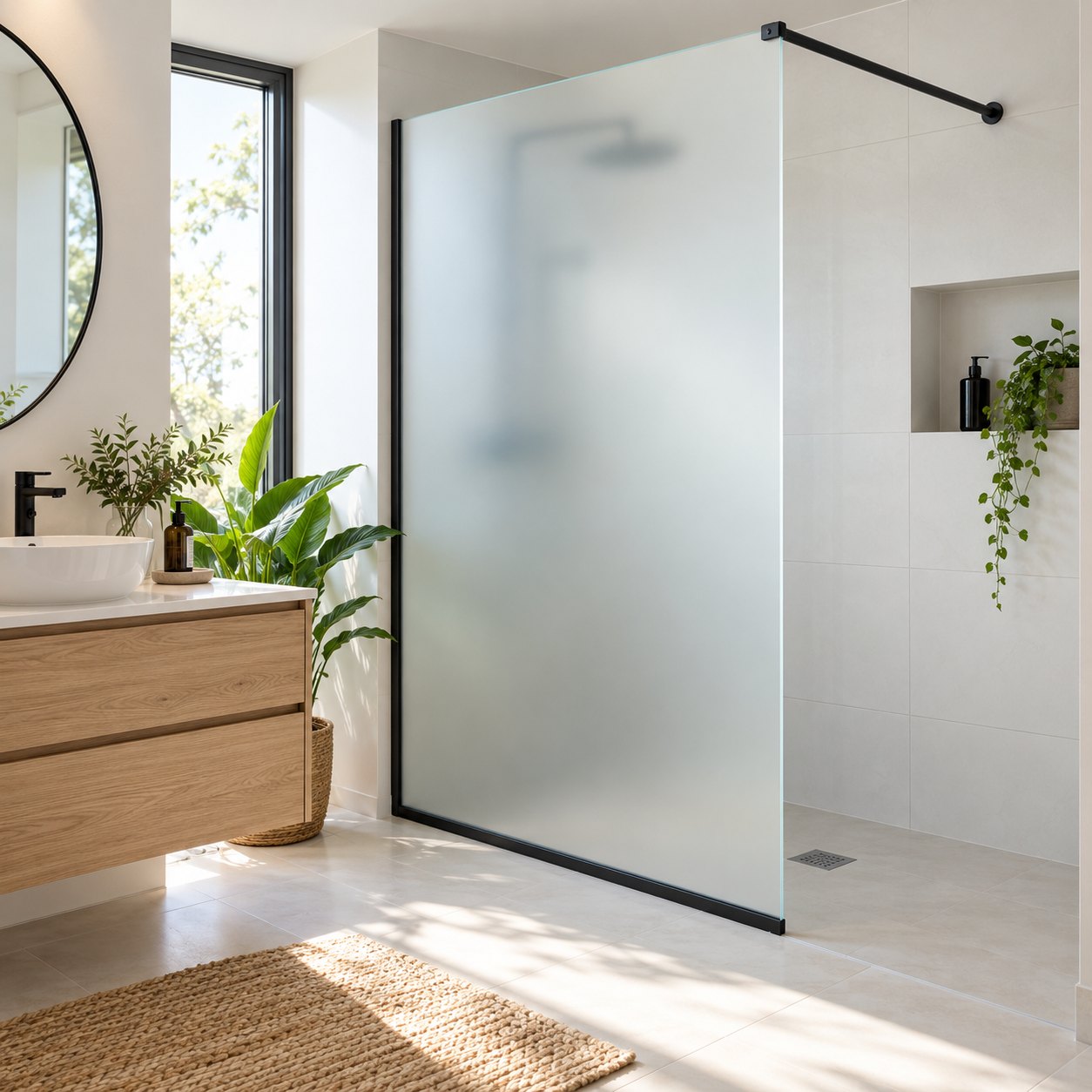
This is the room where frosted glass is most useful. A frosted glass shower screen protects from view while letting light in. It is perfect in an en-suite shower room opening onto a bedroom, a shared bathroom or a walk-in shower.
Our screens are available in clear or low-iron frosted glass, in 6, 8 or 10 mm. 8 mm is the most popular. With black profiles, frosted glass takes on a very contemporary workshop style. With light wood or white, it creates a soft, bright atmosphere.
Two things to know. When wet, the frosted side becomes less matt until it dries: glassmakers advise placing it away from the water, on the bathroom side. And at Plakglass, frosting cannot be combined with the anti-limescale treatment: you have to choose one or the other.
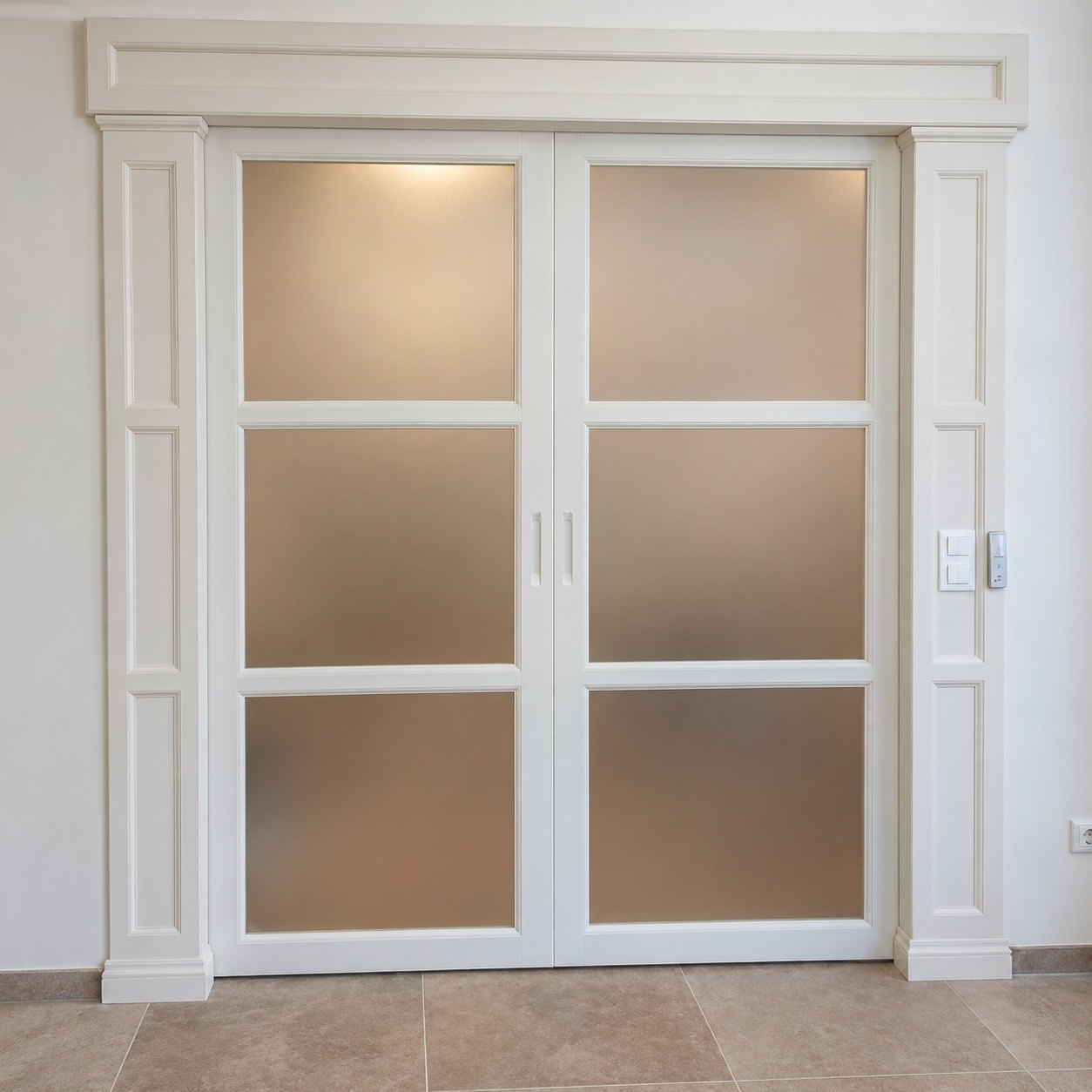
A frosted glass sliding door closes off a room without darkening it. It is suitable for a bedroom, a bathroom, a dressing room or a home office. When open, it slides against the wall and goes unnoticed.
We make it in clear or low-iron frosted glass, in 8 or 10 mm, with a wall-mounted or ceiling-mounted track, in aluminium or black.
Our interior glass partitions are also available in frosted glass, in aluminium or wood: ideal for separating a kitchen, bedroom or office while keeping the light, without being overlooked. Frosted glass is also widely used in partitions, entrances and professional spaces: offices, meeting rooms, reception areas. It creates privacy without cutting off natural light.

You don't need to frost everything to have privacy. With our frosted-effect ceramic printing, the effect can cover just part of the glass, from 20 to 100% of its surface. You hide what needs hiding and keep the view and the light elsewhere.
The most common choice: frosting on the lower part, at the height of a desk, bed or sofa, and transparent glass above. When seated, you are shielded from view. When standing, you keep the view of the next room and all the daylight. Another classic: a frosted band at eye level on a door, which also makes the glass more visible.
It is the ideal solution for a sliding office or bedroom door, a glass partition between a home office corner and the living room, a bathroom door or an entrance pane facing the street.
Configure your frosted-effect printed glass and choose the area of the effect directly on the drawing.
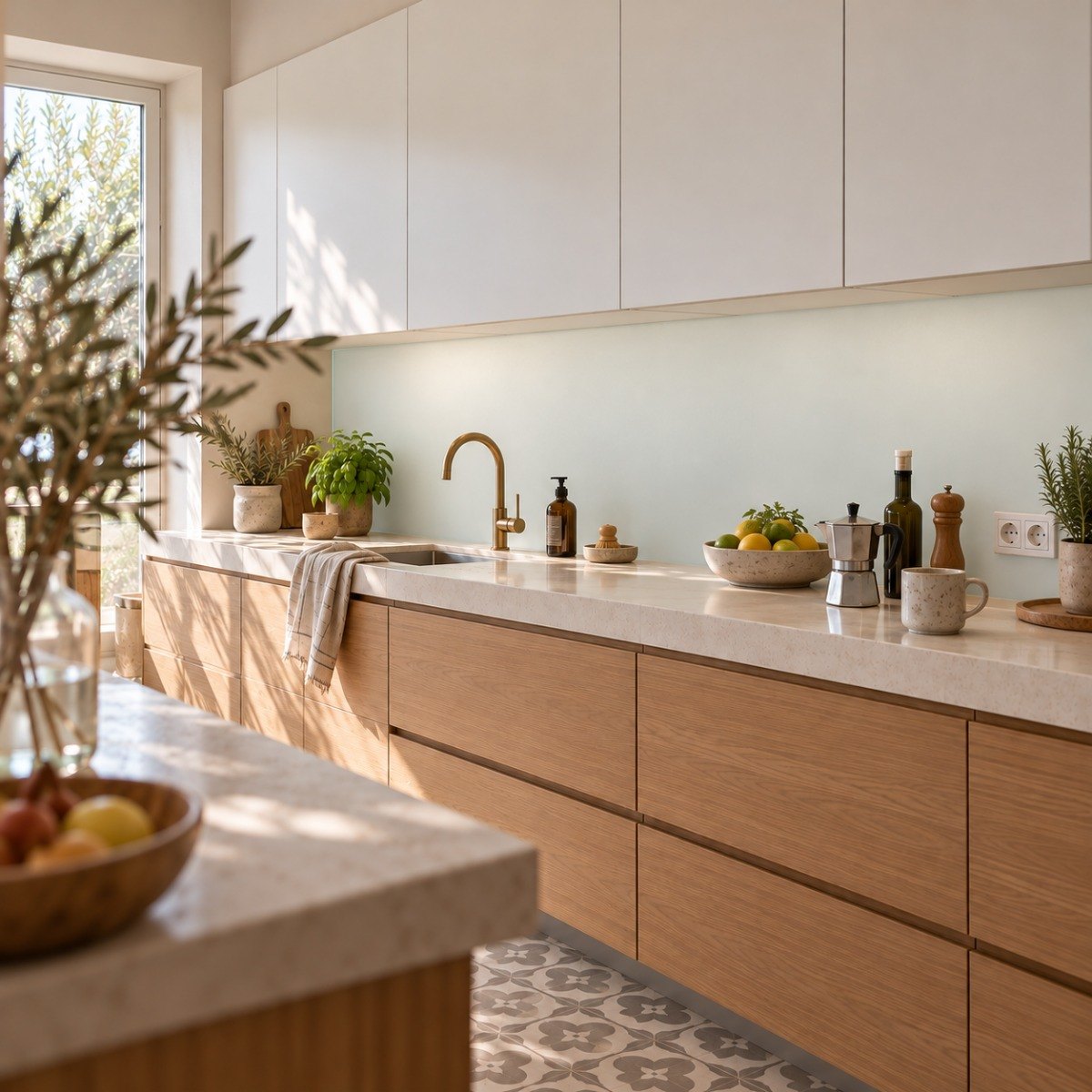
In the kitchen, frosted glass goes well with colour. Our back-painted glass splashback is available in a matt finish: the front face is acid-etched and the colour is lacquered on the back in our workshop in Brittany.
The finish removes reflections and makes the colour softer and more matt. All RAL, NCS and Pantone colours are possible. Behind a hob, choose a thickness of at least 6 mm.
Translucent frosted glass is also used for the fronts and doors of furniture or display cabinets: you can make out the objects without seeing the clutter.
Frosted glass is not limited to bathrooms and doors. Balustrades, shelves, protective plates or furniture: it brings light and discretion wherever a glass surface needs to remain understated.

In frosted toughened laminated glass, from 44/2 to 1010/4, with EVA interlayers for indoor and outdoor use.
A frosted shelf softens an alcove or a bathroom and hides water marks.
Frosted front face, enamel fired on the back: for a worktop, a table top or outdoor use.
Translucent frosted glass hints at the contents of a display cabinet or sideboard without revealing them.
Acid-etched frosting is available on many of our products. For each one, here are the glass types offered, the thicknesses available and the treated side, so you can configure your project with full knowledge.
| Product | Frosted glass types | Thicknesses | Frosted side |
|---|---|---|---|
| Frosted toughened glass | Clear, low-iron | 4 to 19 mm | Front face |
| Shower screen | Clear, low-iron | 6, 8, 10 mm | Front face |
| Sliding door | Clear, low-iron | 8, 10 mm | One side |
| Laminated glass (balustrades) | Clear | 44/2 to 1010/4 | Both sides |
| Matt back-painted splashback | Clear, low-iron | 4 to 19 mm | Front face, lacquer on the back |
| Matt enamelled glass | Clear, low-iron | 6 to 15 mm | Front face, enamel on the back |
Clear frosted glass from {PXMEPRD-dep4CL} per m² in 4 mm, and from {PXMINPRD-dep4CL} per piece.

Acid-etched frosted glass is cleaned like a window: a soft cloth and an alcohol-based glass cleaner, or soapy water. Always clean the whole surface, never just one area, to keep an even appearance. It shows fingerprints less than sandblasted glass.
A greasy mark comes off with a cloth soaked in isopropyl alcohol or acetone, preferably quickly. Avoid scouring sponges, steel wool, razor blades and products containing ammonia or chlorine. Be careful with silicone too: on the frosted side, its marks are usually impossible to remove.
In a shower, a quick wipe with a squeegee after each use limits water marks. As our frosted glass is not available with anti-limescale treatment, this simple habit makes all the difference over time.
You now know all about frosted glass. If you have a project, here is what we offer to make it happen, to your measurements and to the millimetre.
A fine, even finish, in clear or low-iron glass. And for partial frosting, frosted-effect ceramic printing.

All our frosted glass is toughened to the EN 12150 standard and breaks into small, blunt fragments.

From 4 to 19 mm, up to 2,900 × 1,800 mm, with your choice of corners, holes and notches.

Each piece of glass is cut, edge-worked and toughened to order, in French workshops.
They trusted us
Workshop door, table top, plate under a stove: our customers talk about their frosted glass project. All reviews are verified by the Société des Avis Garantis, after a genuine order.
Perfect! Good quality, fair price, well packed, meets my expectations
Translated from French
Quality product, identical to my order in every respect
Translated from French
Very good quality - dimensions very well respected
Translated from French
Good quality, nice work
Translated from French
Matches the description
Translated from French
Faultless quality, the acid-etched frosting is perfect for the industrial-style door I made, thank you
Translated from French
The product was as ordered
Translated from French
As I requested
Translated from French
Product as described and good quality
Translated from French
Best value for money on the market and the products are good quality.
Translated from French
Very satisfactory
Translated from French
Lovely quality product
Translated from French
Product as described and carefully packed
Translated from French
The frosted glass is good quality
Translated from French
Product, no probs
Translated from French
Meets my expectations
Translated from French
Good quality and suited to the expected use
Translated from French
Frosted glass as described
Translated from French
Nothing to report: product as described
Translated from French
The radius of the 4 corners didn't match what I expected; I ticked 60mm in the table because I used a 60mm gauge to estimate the radius of the base, whereas I needed a 30mm radius
Translated from French
As described
Translated from French
Faultless quality
Translated from French
The description just needs to be more precise.
Translated from French
As ordered in every respect.
Translated from French
Superb, the top I received fully meets my expectations
Translated from French
Wet glass, which side to face, the view at night, comparison with a film: here are the answers to the questions we are asked most often about frosted glass. Another question? Our team will answer you from Monday to Friday.
Choosing well
Film is a quick, reversible solution for a pane that is already in place. Frosted glass is more durable: it does not peel off, does not bubble and cleans like a window. For a new shower, door or partition, choose glass.
Both are translucent. Patterned glass, such as our granite-textured 200, has a raised pattern that breaks up the view. Frosted glass keeps a flat, matt surface, with a more understated, contemporary look. Not to be confused with our frosted-effect ceramic printing, which remains smooth.
Frosted glass is translucent: it lets light through and blurs the view. Opal glass, milky white, also diffuses light but conceals more; we offer it in laminated glass. Opaque glass, such as back-painted or enamelled glass, cannot be seen through and lets very little light through, or none at all for dark colours.
It all depends on the use, the dimensions and the fixings. 6 mm is suitable for a splashback, a top resting on a solid piece of furniture or a display cabinet door. 8 mm is the most popular choice for a shower screen. Our thickness guide covers each case in detail.
No. Frosting is a surface finish; toughening is a heat treatment that strengthens glass against impacts and temperature changes. Glass can therefore be frosted without being toughened. At Plakglass, all our frosted glass is toughened, to the EN 12150 standard.
Day to day
Frosted glass is translucent in both directions: no details can be made out. A lit silhouette, very close to the glass, may be visible as a shadow. The further away it moves, the more it blends into the blur. For complete privacy, choose opaque glass, back-painted or enamelled.
It becomes less matt while it is wet, then returns to its usual appearance as it dries. That is why, in a shower, the frosted side is placed away from the water.
In a shower, towards the bathroom, away from the water. In a door or partition, the smooth side is easier to clean: ideally, turn it towards the room that is used most, such as the bathroom.
No, the frosting is part of the surface of the glass: it is etched into the glass surface itself and does not wear off. Unlike a film, it does not peel off or turn yellow. Only abrasives, harsh products and silicone can damage it.
No, not on its own. Frosting affects the view and the diffusion of light, not UV, thermal insulation or sound insulation. These properties depend on the make-up of the glazing: acoustic laminated glass, for example, reduces noise much more effectively.
Manufacture and fitting
Not really. Hydrofluoric acid can be fatal through simple contact with the skin: in industry, it is handled in closed circuits, and sandblasting requires a booth and protective equipment. At home, you are limited to film or frosting spray. The other solution is to replace the pane with made-to-measure frosted glass.
Yes, thanks to frosted-effect ceramic printing: the frosting starts from the bottom of the glass and covers 20% to 100% of its height, with an optional gradient finish. Fired into the glass during toughening, it does not wear off. The upper part stays transparent for the view and the light.
No. Our frosted glass is toughened and can no longer be modified once it has left the toughening furnace. Holes, notches and cut-outs must be planned in the configurator when you order.
This is decided case by case, depending on the thickness and exposure. Wherever there is a risk of falling, single toughened glass is not enough: laminated toughened glass is required, available in frosted glass with interlayers suitable for outdoor use.

This guide is based on official, historical and technical sources, independent of our business:
• US Patent No. 108,408 by B. C. Tilghman, 1870
• R. J. Charleston, “Acid-Etching”, The Glass Circle Journal No. 3, The Glass Society
• Hydrofluoric acid, Chemistry World (Royal Society of Chemistry)
• Toxicological data sheet on hydrofluoric acid, INRS
• Matelux brochure, AGC Glass Europe
• Decorative glass care guide, AGC Glass Europe
• Satinovo data sheet, Saint-Gobain Glass
• Sandblasting of tempered glass (TD-125), Vitro Architectural Glass
• Plastic films applied to glazing (ATS-113), Pilkington
• Specialty Frosted Glass technical data sheet, Rust-Oleum
Window
Text
Hello, I can answer your questions about our products, installation, delivery and order tracking.
Do you have a plan? Attach a drawing, photo, PDF or DXF file with the paperclip, drag it or paste it here: I will set up your shape in the configurator.
For a door hinge, add the drawing or data sheet of your hinge: I place the notches on your shower screen, you check them and then apply them.
Automated assistant: for important information, our customer service is still available.